




Stem cell donation is one of those topics many people know about, but not everyone knows how it actually works in the country where they live. In Poland, many people associate this topic with DKMS, and I knew about it too, although I could not register there at the time. Recently, after watching a ŁatwoGang charity livestream supporting children fighting cancer, I started wondering how stem cell donation works in Sweden, whether there is a Swedish equivalent, who can register, and what the process looks like in practice. I checked, signed up, and after sharing it online, many of you asked for more details. So this guide explains how Tobiasregistret works in Sweden, why stem cell donors are still needed, who can join the registry, and what it really means to become a potential donor.
- How Tobiasregistret started and what it does today
- The biological foundation of stem cell matching
- Donor eligibility: who can join in Sweden?
- The procedural workflow: from registration to laboratory analysis
- Stage 1: digital registration and health declaration
- Stage 2: the swab sampling kit
- Stage 3: laboratory analysis and international indexing
- The matching process and confirmatory screening
- Clinical methods of stem cell collection in Sweden
- Peripheral blood stem cell donation, the most common method
- Bone marrow donation, the surgical method
- Swedish clinical infrastructure and university hospitals
- Karolinska University Hospital (Huddinge and Solna)
- Uppsala University Hospital
- Sahlgrenska University Hospital and Lund Stem Cell Center
- Financial rights and the legal framework for donors
- Anonymity, ethics, and long-term donor support
- Why it matters
How Tobiasregistret started and what it does today
Tobiasregistret is the national system in Sweden responsible for coordinating volunteer blood stem cell donors. It was created in the early 1990s, at a time when Sweden did not yet have a central database that could match unrelated donors with patients.
The registry was founded in 1992 by the parents of Tobias Storch, a 17-year-old who died from a serious blood disease. During his illness, it became clear that the system in Sweden was not prepared to find a suitable donor outside of the family. In cases where no family match was available, patients often had very limited options.
This situation led to the creation of a registry that could collect and organise data from potential donors across the country.
Over time, what started as a private initiative developed into a national, non-profit system. Today, Tobiasregistret is part of the Swedish healthcare structure. It is managed by Region Stockholm and funded by all regions in Sweden, based on their population size.
The main role of the registry is to maintain a database of potential donors. This database can be searched by healthcare providers, both in Sweden and internationally, when a patient needs a transplant.
At the moment, the registry includes over 273,000 people. Even with that number, around 30% of patients in Sweden still cannot find a suitable donor. This shows that the size of the registry is not the only factor. Genetic diversity also plays a key role, which is why new registrations are still important.
World Marrow Donor Association (WMDA) oversees international standards for donor registries. Tobiasregistret follows these standards, which means that recruitment, testing, and stem cell collection are done according to strict medical and ethical guidelines.
This also allows donors registered in Sweden to potentially help patients in other countries, not only locally.
The biological foundation of stem cell matching
The success of a stem cell transplant depends on how closely the donor and the patient match on a genetic level. This is measured through the Human Leukocyte Antigen system, known as HLA.
HLA markers are proteins found on the surface of most cells in the body. They help the immune system recognise what belongs to the body and what should be treated as foreign. In the context of a transplant, this becomes critical.
If the HLA match is not close enough, the patient’s body may reject the new cells. At the same time, the donor’s immune cells may attack the patient’s body. This reaction is called Graft-Versus-Host Disease (GVHD), and it can be life-threatening. This is why matching is such a complex and important part of the process.
Genetics and ethnic diversity in matching
Unlike blood groups, which have a limited number of types, the HLA system is extremely diverse. There are thousands of possible combinations.
These markers are inherited from your parents. This means the highest chance of finding a match is usually among people with a similar genetic background. In practice, this often means people from the same ethnic or geographical group. This is why diversity in registries like Tobiasregistret is so important. A more diverse registry increases the chances for patients who might otherwise struggle to find a match.
For some people, especially those from underrepresented backgrounds, this can directly affect whether a transplant is even possible.
The role of donor age and gender in outcomes
Medical data shows that the age and gender of the donor can also influence how successful a transplant will be.
Younger donors, usually between 18 and 35, are preferred. Their stem cells tend to be stronger, which can help the patient recover faster and reduce the risk of complications.
There is also a clinical preference for male donors in many cases. One reason is physical. Men usually have a larger body volume, which makes it possible to collect more stem cells.
Another factor is related to pregnancy. Women who have been pregnant may develop certain antibodies, which can increase the risk of complications like Graft-Versus-Host Disease in the patient.
| Clinical preference factors | Reasoning and impact |
|---|---|
| Age (18–35) | Younger cells correlate with higher survival rates and better recovery. |
| Male Gender | Higher cell volume and lack of pregnancy-related antibodies. |
| BMI (up to 40) | Ensures donor safety during anesthesia and efficient cell harvest. |
| Weight (>50 kg) | Necessary to ensure a sufficient quantity of cells for the recipient. |
Donor eligibility: who can join in Sweden?
To protect both the donor and the patient, Tobiasregistret has clear rules for who can register. These rules help make sure that the donation process is safe for the donor, while also reducing the risk of passing any disease or medical complication to a patient whose immune system may already be very weak.
Primary requirements
To join Tobiasregistret in Sweden, you need to meet a few basic requirements:
- you must live in Sweden
- you must have a valid Swedish identity document
- you must have a Swedish personal identity number, called personnummer
- you must be between 18 and 35 years old when registering
- you must weigh at least 50 kg
- your BMI must not be higher than 40
The age limit applies only to new registrations. If you are accepted into the registry, you can stay there until the age of 60.
The reason for focusing on younger donors is medical. Younger donors are often preferred because their stem cells usually give better results for patients and may reduce the risk of complications after the transplant.
Medical conditions that may stop you from registering
The general rule is that a donor should be in very good health. A temporary cold or a minor infection does not usually stop you from joining, but serious or chronic health problems often can.
You usually cannot register if you have, or have had, conditions such as:
- serious heart or lung diseases, including previous heart surgery, heart disease, COPD, emphysema, or pulmonary embolism
- autoimmune diseases that require treatment or regular medical monitoring, such as multiple sclerosis, rheumatoid arthritis, SLE, Sjögren’s syndrome, or Addison’s disease
- any current or previous cancer diagnosis
- blood disorders or infectious diseases, including hemophilia, HIV, hepatitis B, hepatitis C, or HTLV
- insulin-dependent diabetes, severe psoriasis, or a previous organ or tissue transplant
- epilepsy, unless you have been seizure-free for at least 12 months without medication
At the same time, not every diagnosis automatically excludes you. People with ADHD can usually register. Mild allergies or asthma are also usually accepted, as long as they do not strongly affect everyday life.
However, people who are on long-term sick leave or need regular medical supervision for chronic conditions are generally advised not to join.
The procedural workflow: from registration to laboratory analysis
The process of joining Tobiasregistret is made to be simple for the donor, but still medically accurate. You do not need to go anywhere at the beginning. The first steps happen online and at home, before your genetic profile is added to the donor database.
Stage 1: digital registration and health declaration
The first step is done on the Tobiasregistret website. You fill in a digital health declaration with questions about your:
- medical history
- lifestyle
- age and weight
- general health
- physical details needed for eligibility
This first form works as an initial check. It helps the registry see whether you meet the basic age and health requirements before they send you the sampling kit.
Stage 2: the swab sampling kit
If your health declaration is accepted, Tobiasregistret sends a swab kit to your home address. The kit includes special swabs that are used to collect a DNA sample from the inside of your cheek.
The process is non-invasive and only takes a few minutes. You simply rub the swabs against the inside of your cheek to collect cells. These cells contain the genetic information needed to identify your HLA profile.
Stage 3: laboratory analysis and international indexing
After you send the swabs back, they are sent to a laboratory for analysis. The lab checks your unique HLA profile, which is the information needed to see whether you could be a match for a patient.
For privacy reasons, your data is connected to a donor code rather than openly shared with your name. The information is stored in a secure database and can also be searched through international donor systems.
This means that if you register in Sweden, you are not only a potential donor for someone in Sweden. You could also become a match for a patient in another country.
Once the laboratory process is complete, you are officially registered as a potential donor. After that, you stay in the registry until you are matched with a patient or until you reach the age limit.
The matching process and confirmatory screening
When a patient anywhere in the world needs a stem cell transplant, their medical team searches connected donor registries to find a suitable match. If a person registered in Sweden looks compatible based on their HLA profile, Tobiasregistret starts a more detailed checking process called confirmatory typing.
Initial notification and decision
If you are identified as a possible match, Tobiasregistret contacts you and explains the situation. At this stage, you are still not forced to donate. Participation remains voluntary, and you can decide whether you are willing to continue.
If you agree, you receive updated information about the next steps. You may then be reserved for that specific patient for around three to four months. During that time, you are not matched with another patient, because the medical team needs time to confirm whether you are the best donor.
Advanced medical evaluation
Before any donation can happen, you need to go through a full health check-up. This is done free of charge at a university hospital and is there to protect both you and the patient.
The evaluation usually includes:
- Detailed blood tests
These tests confirm the HLA match in more detail and check for infectious diseases. This is important because your health status may have changed since your first registration. - Physical examination
A doctor checks your general health and makes sure you are fit for the procedure. This can include an EKG and, in some cases, a chest X-ray, especially if the donation method may require general anaesthesia. - Information and consent session
You also attend a longer information session, usually around 90 minutes. A medical professional explains the donation methods, possible risks, and side effects. After that, if you still want to continue, you sign a formal consent form.
Clinical methods of stem cell collection in Sweden
There are two main ways to collect blood stem cells from a donor in Sweden. The method is usually chosen by the patient’s doctor, based on the patient’s diagnosis and medical needs. The donor’s preference can also be considered, but the patient’s medical situation is the most important factor.
Peripheral blood stem cell donation, the most common method
Around 90% of stem cell donations in Sweden are done through peripheral blood stem cell donation, often shortened to PBSC. This is the most common method and does not involve surgery. In practice, it is closer to donating blood or plasma, although the preparation is different.
Pre-donation preparation: G-CSF injections
Stem cells are normally found mainly in the bone marrow. Only a small number of them circulate in the blood. To move more stem cells into the bloodstream, the donor receives daily injections of a hormone called G-CSF, which stands for Granulocyte Colony-Stimulating Factor.
These injections are usually given for four to five days before the donation. They are often injected into the stomach area and can be done at home or at a local health centre.
The most common side effects are temporary and can include:
- headache
- bone pain
- muscle pain
- tiredness
- flu-like symptoms
These symptoms usually disappear after the injections stop.
The apheresis procedure
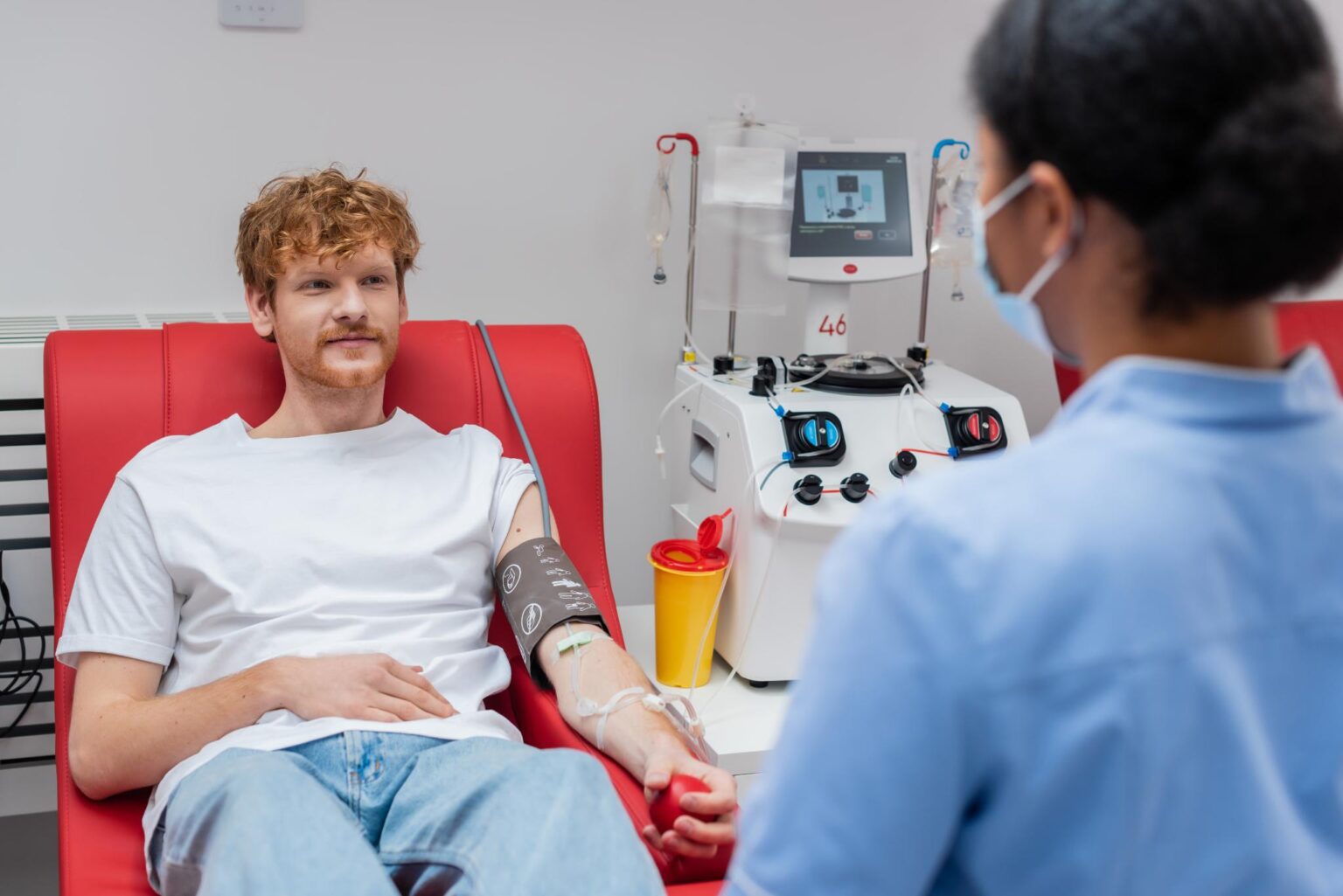
The actual donation takes place at an apheresis unit in a university hospital. Blood is taken from a vein in one arm and passed through a machine that separates the stem cells from the rest of the blood.
The remaining blood components, such as red blood cells, plasma, and platelets, are then returned to the donor through a vein in the other arm.
The procedure usually takes around four to six hours. During this time, the donor stays in a bed or reclining chair and can usually read, watch something, or rest.
In some cases, not enough stem cells are collected during the first session. If that happens, the donor may need to come back for a second session the next day.
Bone marrow donation, the surgical method
In around 10% of cases, stem cells are collected directly from the bone marrow. This method is less common, but it can be preferred in some medical situations, for example for children or for patients with certain types of anemia or immune disorders.
One reason is that bone marrow cells may be connected with a lower risk of chronic Graft-Versus-Host Disease.
The procedure under anaesthesia
Bone marrow donation is a surgical procedure done in an operating room under general anaesthesia. This means the donor is asleep during the procedure.
Doctors use special needles to collect liquid marrow from the back of the pelvic bone, called the posterior iliac crest. The procedure usually takes one to two hours.
Recovery after bone marrow donation
After the procedure, the donor is monitored in a recovery room. Many donors can go home the same day, although in some cases an overnight stay may be needed.
The most common side effect is soreness or stiffness in the lower back. Many people describe it as similar to the feeling after a hard fall on ice. This discomfort usually lasts for a few days and can often be managed with regular painkillers.
Most donors are able to return to normal activities within about a week.
| Comparison of donation methods | PBSC (Apheresis) | Bone marrow (Surgery) |
|---|---|---|
| Frequency of use | ~90% of cases | ~10% of cases |
| Preparation | 4–5 days of G-CSF injections | None |
| Anesthesia | None | General anesthesia |
| Procedure duration | 4–6 hours | 1–2 hours |
| Recovery site | Outpatient / Home | Hospital (briefly) / Home |
| Common side effects | Flu-like symptoms (pre-donation) | Soreness in the lower back |
Swedish clinical infrastructure and university hospitals
Stem cell donation and transplantation in Sweden are handled by specialised university hospitals. These are large academic medical centres with the staff, equipment, and experience needed to manage both the donor process and the patient’s treatment.
Most of the practical steps, such as medical evaluations, donations, and transplants, take place in these hospitals.
Karolinska University Hospital (Huddinge and Solna)
Karolinska University Hospital is the main centre for advanced cell therapies in Sweden.
The Department of Cell Therapy and Allogeneic Stem Cell Transplantation (CAST) in Huddinge performs the highest number of stem cell transplants in the country. This unit specialises in complex cases and advanced treatments.
The hospital is also JACIE-accredited, which is an international quality standard in this field. This means the procedures meet strict requirements for safety and medical quality.
Karolinska is also one of the leading centres working with newer treatments, including CAR-T cell therapy.
Uppsala University Hospital
Uppsala University Hospital has a strong background in medical research and life sciences.
It was one of the first hospitals in Europe to treat cancer patients with CAR-T cells in a clinical trial. The hospital works closely with Uppsala University, which allows new research to be introduced into real patient care.
For donors and patients, this means access to modern treatment methods and ongoing medical developments.
Sahlgrenska University Hospital and Lund Stem Cell Center
Sahlgrenska University Hospital is one of the main centres for western Sweden.
It provides full support for both donors and patients in this region and is often a practical location for people living in or around Gothenburg. It is also a common place for English-speaking donors to go through the process.
Another important institution is the Lund Stem Cell Center, which focuses more on research and development.
The centre works on new types of therapies, including the use of induced pluripotent stem cells (iPSCs), which may play a role in future regenerative medicine.
Together, these institutions form the core of Sweden’s stem cell treatment system, combining clinical care with ongoing research and development.
Financial rights and the legal framework for donors
In Sweden, stem cell donation is based on one key principle: it must be voluntary and unpaid. This means you cannot receive money for donating stem cells.
The reason is simple. The system is designed this way to protect both the donor and the patient. If money was involved, there would be a risk that people might hide important health information, which could make the procedure unsafe.
At the same time, the system is built so that donation does not cost you anything.
Reimbursement of expenses
All direct costs related to the donation are covered by the healthcare system and Tobiasregistret.
This usually includes:
- travel to and from the university hospital
- hotel accommodation, if needed
- meals during the donation period
- costs for a companion, if you need someone to come with you
You may also be able to get back smaller expenses, such as parking, as long as you keep the receipts.
The idea is that you should not lose money because you decided to help.
Compensation for lost wages: Försäkringskassan
If you need to take time off work for medical checks or for the donation itself, you can get compensation for lost income. In Sweden, this is handled through Försäkringskassan. There is a special rule called Särskilt högriskskydd, which is used in situations like this.
Normally, when you are on sick leave in Sweden, there is a waiting day at the beginning when you do not get paid. In this case, that rule does not apply. This means you can receive compensation from the first day of your absence.
Tobiasregistret helps with this part as well by providing the documents and forms you need to submit your claim.
Anonymity, ethics, and long-term donor support
The relationship between a stem cell donor and a patient is handled very carefully. The rules are there to protect both sides from emotional pressure and to make sure everyone’s privacy is respected.
The principle of anonymity
In Sweden, as in many other countries, the donor and the patient stay anonymous to each other for at least one year after the transplant.
During the donation process, neither side receives identifying information about the other person. The donor may be told some general details about the patient, such as:
- approximate age
- gender
- country of residence
However, names, exact locations, and other identifying details are not shared.
Communication and future contact
Even during the anonymous period, it may be possible to exchange greetings. This is done through letters that are checked by Tobiasregistret before being passed on.
These letters cannot include names, addresses, or details that would reveal who the person is.
After at least one year, direct contact may be possible, but only if:
- both the donor and the patient agree to it
- both sides sign a consent form
- the laws in the patient’s country allow it
This last point is important because the rules are not the same everywhere. Some countries, such as France, never allow donor and patient anonymity to be removed. Others may require a longer waiting period, sometimes up to five years.
Post-donation health monitoring
Tobiasregistret also follows donors after the donation. This is done to check both physical and mental well-being, not only immediately after the procedure, but also in the long term.
Follow-ups are usually done after:
- one year
- five years
- ten years
This information helps make sure donors are doing well after donation. It is also part of the international work to keep stem cell donation as safe and effective as possible.
Why it matters
Joining Tobiasregistret is a real commitment, but it is also one of the most practical ways to help another person. Most registered donors will never be called to donate, but simply being in the database still matters. For someone with a life-threatening blood disease, one matching donor can change everything.
The Swedish system is well organised, medically controlled, and built to protect the donor. The process is unpaid, but it should also be cost-neutral, which means your direct expenses are covered. In many cases, donation means a few hours of your time, some temporary discomfort, and a short recovery period.
For the patient, it can mean something much bigger: a chance to live.
This is why more registered donors are still needed, especially people from different genetic backgrounds. The more diverse the registry becomes, the higher the chance that more patients will find a match.
So if you live in Sweden, meet the health requirements, and feel ready for this kind of commitment, it is worth checking whether you can register. It costs almost nothing, but for someone else, it may be priceless.