



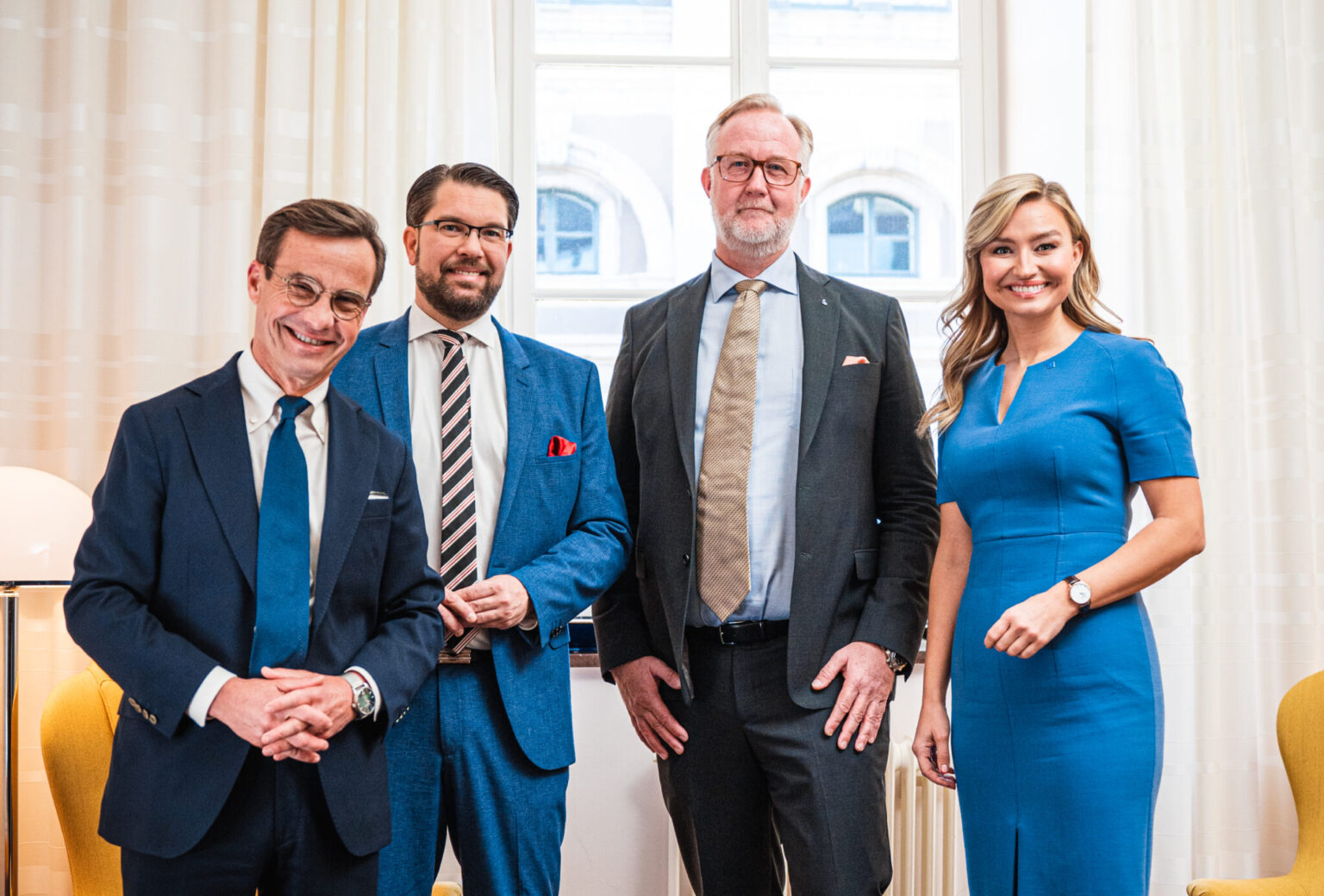

If you have been living in Sweden since 2022 — or if you have been following Swedish politics from abroad — you have almost certainly come across the term Tidöavtalet. It comes up in conversations about immigration, crime, school policy, energy, and welfare. Politicians invoke it constantly. Critics warn about its consequences. Supporters say it is exactly what the country needed.
- What is the Tidö Agreement and where does it come from?
- How the agreement actually works: the Coordination Commission
- Migration and asylum: the “paradigm shift”
- Permanent residence permits are being phased out
- Citizenship is now harder to obtain
- Family reunification and voluntary return
- Work permit thresholds raised
- Integration policy: from support to obligation
- Crime and law enforcement: expanded powers
- Energy policy: the nuclear turn
- Education policy: back to basics
- What has actually been implemented versus what is still coming
- The notification duty: Sweden’s most controversial measure
- Reactions: who supports it and who opposes it
- The 2026 kvittning scandal and the state of the agreement
- What this means if you live in Sweden
But what is it, exactly? Who signed it, what does it actually say, and — most importantly for anyone living in Sweden — what has it changed in practice? This guide answers all of those questions as clearly and factually as possible.
What is the Tidö Agreement and where does it come from?
The Tidö Agreement (Tidöavtalet) is a 63-page governing document signed in October 2022 at Tidö Castle (Tidö slott) in Västmanland, central Sweden. It was signed by the four parties that together form the current parliamentary majority: the Moderate Party (M), the Christian Democrats (KD), and the Liberal Party (L) — who form the actual government cabinet — and the Sweden Democrats (SD), who support the government from outside the cabinet.
This distinction matters. The Tidö Agreement is not a formal coalition. The Sweden Democrats hold no ministerial posts and are not part of the government in the constitutional sense. Instead, the arrangement is what political scientists call a supply-and-confidence agreement: the Sweden Democrats agree to vote for the government’s budget and to support it in confidence votes, and in exchange, the government commits to pursuing a specific policy agenda defined in the 63-page document.
Together, the three governing parties hold 103 seats in the 349-seat Riksdag. With the Sweden Democrats’ 73 seats, the bloc controls 176 seats — a majority of exactly one. This is the mathematical foundation of the entire arrangement.
Why is this historically significant?
For most of the period from 2010 to 2022, both the left and right blocs refused to formally cooperate with the Sweden Democrats, treating them as a party outside the boundaries of mainstream politics. The Tidö Agreement ended that exclusion on the right. It is the first time in modern Swedish history that a governing program has been formally negotiated with and agreed to by the Sweden Democrats, giving them direct influence over government policy without holding cabinet seats.
How the agreement actually works: the Coordination Commission
One of the most unusual features of the Tidö arrangement is the administrative mechanism that keeps it running: the Coordination Commission (samordningskommissionen or samordningskansliet), located within the Government Offices (Regeringskansliet) at Rosenbad in Stockholm.
Although the Sweden Democrats are not in the cabinet, they maintain a team of approximately nine political advisors embedded within the Government Offices. This unit, led by Gustav Gellerbrant, operates as a pre-screening body for all government proposals. Before any bill or directive reaches the cabinet table, the Sweden Democrats’ coordination office reviews it. This ensures that nothing advances without SD’s approval — giving the party real, day-to-day influence over legislation despite the absence of a formal ministerial role.
The agreement divides its content into seven cooperation projects, each addressing what the four parties describe as a major societal challenge: growth and household economy, crime and punishment, migration and integration, climate and energy, healthcare, education, and welfare and civil society.
Migration and asylum: the “paradigm shift”
The most far-reaching changes introduced under the Tidö Agreement are in migration and asylum policy. The document explicitly calls for a “paradigm shift” — a move from what it describes as a rights-based approach to a restrictive, demand-based model that brings Sweden down to the minimum standards allowed under EU law.
Permanent residence permits are being phased out
One of the most significant structural changes is the effective end of permanent residence permits (permanent uppehållstillstånd, or PUT) for asylum-related cases. The government is replacing permanent status with three-year renewable temporary permits, contingent on the continued need for protection. This means that people who previously would have received a permanent right to stay in Sweden now receive a time-limited permit that must be renewed.
Citizenship is now harder to obtain
A new citizenship law is set to enter into force on June 6, 2026, introducing the most demanding requirements in Sweden’s modern history. The key changes are:
The residency requirement increases from five to eight years for most applicants. Applicants must pass mandatory language and civic knowledge tests. A new self-sufficiency requirement (självförsörjningskrav) means applicants must demonstrate they can support themselves without social assistance. An expanded character assessment (vandel) allows citizenship to be denied on the basis of debt to the state, associations with criminal networks, or substance abuse.
Family reunification and voluntary return
Rules on family reunification were tightened in 2023, raising the minimum age for spouses to 21 years — a measure aimed at preventing forced marriages. The government has also significantly expanded its voluntary repatriation (återvandring) program. From January 1, 2026, individuals choosing to return to their country of origin can receive up to 350,000 SEK, and families can receive up to 600,000 SEK — a substantial increase from previous levels.
Work permit thresholds raised
The salary threshold for work permits was raised to 80% of the median Swedish wage in 2023, and is scheduled to reach 90% of the median (approximately 33,390 SEK per month) by June 1, 2026. This change has made it significantly harder for employers to hire from outside the EU at lower wage levels, and has affected a considerable number of work permit applications in sectors such as IT, healthcare support, and food services.
Integration policy: from support to obligation
Integration policy under the Tidö Agreement has shifted from a model centered on state-provided support to one based on individual obligation and conditionality.
SFI: a three-year limit introduced
The Swedish for Immigrants program (Svenska för invandrare, SFI) was overhauled on January 1, 2026. A three-year time limit was introduced on the right to participate in SFI, with extensions available for specific reasons such as illness or parental leave, but with a total cap of six years. The stated logic is to incentivize faster language acquisition.
Housing for new arrivals: a 36-month cap
A bill submitted in March 2026 (Prop. 2025/26:215) introduces time-limited housing for certain newly arrived individuals. From January 1, 2027, municipalities will only be obliged to provide housing for a maximum of 36 months. Municipalities will also gain more influence over where newly arrived people are allocated, with allocations taking into account existing levels of exclusion and local housing market conditions.
Welfare conditionality
The government is developing a welfare ceiling (bidragstak) designed to ensure that total monthly benefits received by a household do not exceed a specific percentage of an entry-level salary. Proposals for 2027 also include requiring five years of residency within a 15-year period to qualify for full child and housing allowances. These measures are intended to strengthen what the government calls arbetslinjen — the principle that working should always be more financially rewarding than receiving benefits.
Crime and law enforcement: expanded powers
Addressing gang crime and organized violence is the highest stated priority of the Tidö government, and the area where the most visible new legal tools have been introduced.
Search zones
In April 2024, Sweden introduced visitationszoner — search zones — allowing police to conduct stop-and-search operations in designated areas without requiring individual suspicion of a specific crime. The zones are targeted at removing weapons and explosives from high-crime areas and can be declared by police in any part of the country.
Harsher sentencing
The government has introduced a package of sentencing reforms. Gang-related crimes are now subject to doubled sentences. The previous sentencing reduction for young adults aged 18–21 has been abolished. A new legal category of criminal gang membership has been established, making it possible to prosecute individuals for their participation in a criminal network even without a specific criminal act. Sweden has also established the legal framework for anonymous witnesses in serious criminal trials.
A bill submitted in April 2026 proposes lowering the age of criminal responsibility to 13 years for the most serious crimes.
Police expansion
The government has reached its target of 10,000 additional police employees — a goal set before the Tidö Agreement but accelerated under it. The focus for 2026 and beyond is increasing the number of uniformed officers in active street service. The 2026 police budget reached 48.4 billion SEK, an increase of 3 billion SEK from the previous year.
Expanded surveillance
The 2026 Spring Budget allocated additional funding for high-definition surveillance cameras and tools for tracking encrypted communications. Police have also been granted expanded powers to use wiretapping and electronic monitoring during the intelligence-gathering phase, before a crime has been formally committed.
Energy policy: the nuclear turn
The Tidö Agreement marks the formal end of Sweden’s 40-year nuclear phase-out policy. The government has redefined the national energy target from “100% renewable” to “100% fossil-free” — a change of one word that explicitly and deliberately includes nuclear power as a long-term solution.
To facilitate the construction of new reactors, the government has removed the legal ban on building reactors at locations other than existing nuclear sites, abolished the limit of ten simultaneous reactors in operation, and established 400 billion SEK in state credit guarantees to reduce the financial risk for investors. Vattenfall, the state-owned energy company, has received new owner directives to begin planning for large-scale reactors and Small Modular Reactors (SMRs).
A dedicated cabinet-level working group was formed in 2023 to coordinate state involvement in nuclear expansion.
Education policy: back to basics
Education reform under the Tidö Agreement is centered on reversing what the government views as decades of declining academic standards caused by the decentralization of schools to municipalities in the 1990s.
The most visible change already implemented is the Reading Guarantee (läsgaranti): a shift back to physical books over digital tablets in early grades, with the 2026 budget allocating over half a billion SEK annually for physical textbooks.
Teachers have been given expanded authority to maintain classroom order, including the right to search bags for prohibited items and to move persistently disruptive students to separate units (akutskolor). Grading standards have been tightened to reduce grade inflation by linking grades more closely to national exam results.
A major government inquiry is ongoing into the return of school governance from municipalities to the state — the most structurally ambitious education reform proposed, but not yet enacted as legislation.
What has actually been implemented versus what is still coming
By mid-2026, a substantial portion of the Tidö agenda has moved from document to law. Here is a clear overview:
| Change | Status |
|---|---|
| Work permit salary threshold raised (80% of median) | Implemented 2023 |
| Spousal age for family reunification raised to 21 | Implemented 2023 |
| Search zones (visitationszoner) | Implemented April 2024 |
| Youth sentencing discount abolished (18–21) | Implemented |
| Criminal gang as legal category | Implemented |
| SFI three-year time limit | Implemented January 2026 |
| Nuclear phase-out reversed, 400bn SEK guarantees | Implemented |
| Citizenship: 8-year residency + language tests | Entering force June 6, 2026 |
| Character assessments for permit revocation | Entering force July 13, 2026 |
| Notification duty for six public agencies | Entering force July 13, 2026 |
| Time-limited housing for new arrivals | Proposed, entering force January 2027 |
| Welfare ceiling | Proposed for 2027 |
| State governance of schools | Under inquiry, not yet legislated |
| Age of criminal responsibility lowered to 13 | Proposed, April 2026, expected to enter force August 2026 |
The notification duty: Sweden’s most controversial measure
One of the most hotly debated provisions still in progress is the notification duty (anmälningsplikt) — a requirement for certain public authorities to report undocumented individuals to the police.
After significant pressure from teachers, doctors, social workers, and trade unions, the government exempted healthcare, schools, and social services from this obligation. However, the duty still applies to six other agencies including the Swedish Public Employment Service (Arbetsförmedlingen) and the Swedish Social Insurance Agency (Försäkringskassan). Critics, including Civil Rights Defenders and the teachers’ union Sveriges Lärare, argue that even the partial implementation undermines the trust that public institutions depend on.
Reactions: who supports it and who opposes it
The Tidö Agreement has generated deeply polarized reactions in Sweden and internationally.
Supporters — primarily voters and politicians on the Swedish right — argue that the agreement is a necessary correction after years of high migration, rising gang violence, and unsustainable welfare costs. They point to falling asylum numbers, rising police budgets, and the energy policy pivot as evidence that the government is delivering on its mandate.
Critics — including Amnesty International, Civil Rights Defenders, opposition parties, and several EU institutions — argue that the agreement erodes the rule of law, stigmatizes immigrants, and introduces surveillance and punitive measures that conflict with human rights standards. A 2023 survey by Civil Rights Defenders found that 59% of Swedes were worried the country was moving in an undemocratic direction, up from 44% in 2022. The Council of Europe’s Commissioner for Human Rights has written to the Swedish government expressing concern about several provisions.
Trade unions, particularly in the public sector, have strongly opposed the notification duty and welfare conditionality measures, arguing they undermine the professional ethics of civil servants and damage the institutional trust that Swedish public administration depends on.
The 2026 kvittning scandal and the state of the agreement
As of May 2026, the Tidö Agreement remains functionally intact, but tensions have reached a critical level in the months before the September 2026 general election.
In April 2026, the Sweden Democrats were accused of deliberately breaking the kvittning (pairing) protocol — the century-old parliamentary practice by which parties mutually agree to keep absent members from voting, to maintain the balance of the chamber. During a vote on transitional rules for the new citizenship law, SD sent two MPs to vote despite having agreed to be absent. The motion for transitional rules — which would have protected existing applicants from the new 8-year residency requirement — was defeated by exactly one vote.
The Green Party’s Annika Hirvonen called for a formal re-vote, describing the incident as an unprecedented breach of parliamentary trust. The episode triggered a crisis meeting called by the Speaker and damaged the informal norms that keep Swedish parliamentary cooperation functioning.
Despite this, a full collapse of the agreement before the election is considered unlikely, as all four parties have a shared interest in completing the Tidö agenda before voters go to the polls. The Sweden Democrats have, however, made clear that they expect formal cabinet positions in any future right-wing government after September 2026 — a demand that would represent a further step in their integration into mainstream Swedish governance.
What this means if you live in Sweden
The Tidö Agreement has changed the rules for a significant number of people living in Sweden. If you are a non-EU immigrant, the citizenship timeline is longer, the residency conditions are stricter, and the path to permanent status is more conditional than it was three years ago. If you are on social assistance, new activity requirements and the coming welfare ceiling will affect how benefits are calculated. If you have children in school, the return to physical textbooks and stricter classroom rules are already in effect. If you live in certain urban areas, police search zones are now a legal reality. And if you are thinking about Sweden’s energy future, the country is now firmly committed to building new nuclear capacity.
None of these changes happened in isolation. They are all part of the same document, negotiated by four parties at a castle in Västmanland in October 2022, and they reflect a deliberate choice about what kind of country Sweden wants to be in the years ahead.
If you have questions about any specific part of the agreement — particularly how it might affect your own situation in Sweden — leave a comment below. And if this kind of detailed breakdown of Swedish society is useful to you, the LikeSweden newsletter will keep you informed as the political situation continues to develop ahead of the September 2026 election.





![Silver Jewellery-Making Workshop in Göteborg – Creativity, Connection & Local Craft [January 2025] – LikeSweden](https://likesweden.com/wp-content/uploads/2025/01/PIKU0731-1-2-330x220.jpg)