



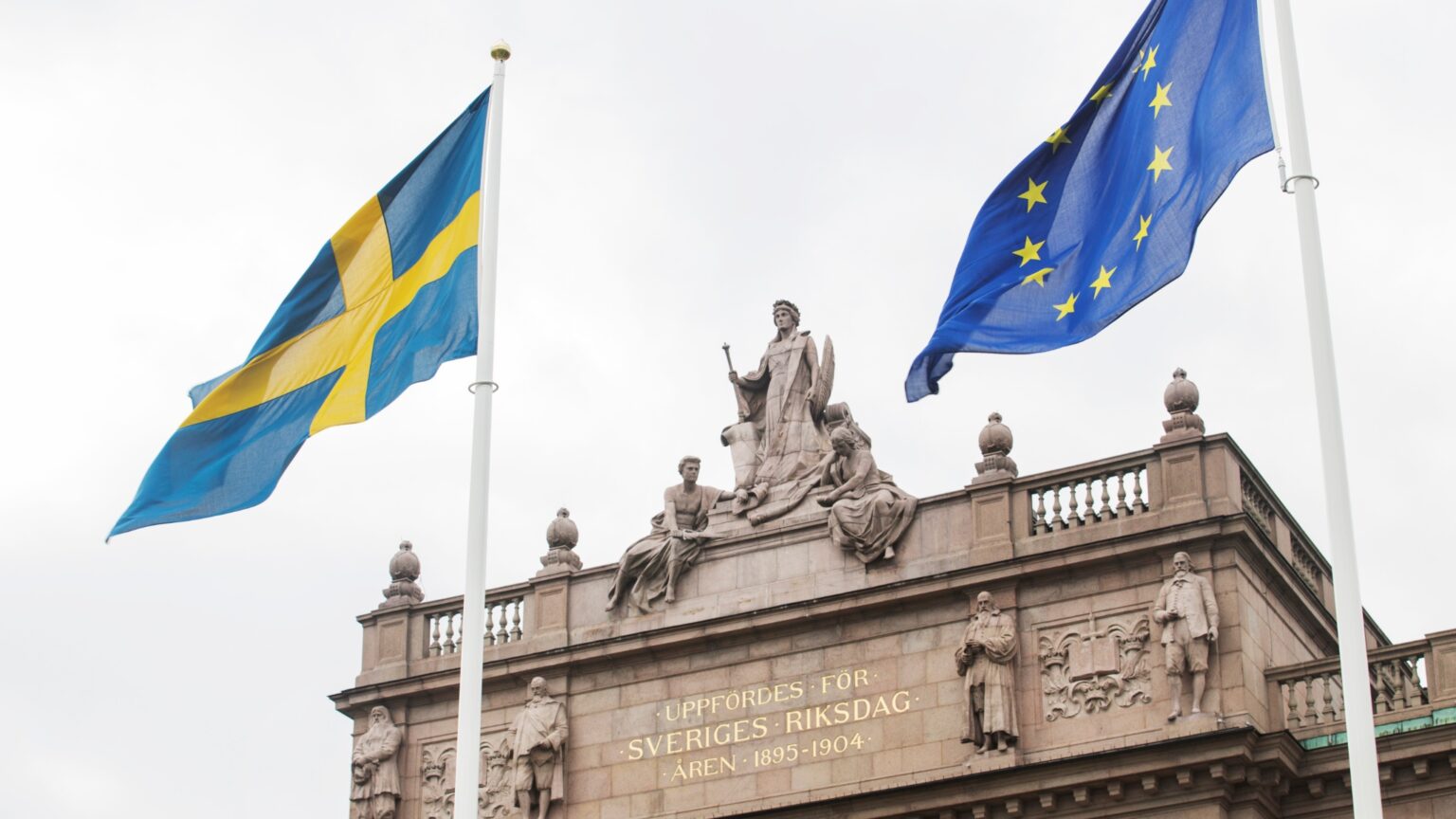

If you have ever tried to explain Swedish politics to someone back home, you probably noticed that some things are surprisingly hard to translate. Not because of the language, but because the concepts simply do not exist the same way elsewhere. Sweden has one parliament, not two. Laws are consulted on before they are written, not after. The king signs nothing. And at one point in the 1970s, actual national policy was decided by drawing lots. Out of a hat. In a room full of elected politicians.
- What is the Riksdag and how did it end up with exactly 349 seats?
- Sweden vs the rest: what does having only one chamber actually change?
- The four fundamental laws: Sweden’s constitution is not one document
- From idea to law: how the Swedish legislative process actually works
- Step 1: Government inquiry (utredning)
- Step 2: Remiss consultation
- Step 3: Lagrådet review
- Step 4: Proposition or motion?
- Step 5: Committee work (utskott)
- Step 6: Debate and vote
- Step 7: Publication in SFS
- Kvittning: the quiet agreement that keeps Swedish politics stable
- The talman: Sweden’s most powerful elected official you have probably never heard of
- Negative parliamentarism: why minority governments are normal in Sweden
- Citizen participation: how open is the Swedish legislative process?
- A few things about Sweden’s system that genuinely surprise most foreigners
- Swedish lawmaking: efficient by design, not by accident
Once you start pulling at these threads, the Swedish system turns out to be genuinely fascinating — and quite different from what most immigrants, whether from the UK, the US, Germany, Poland, or anywhere else, are used to. This guide walks you through how it all works, from the structure of the Riksdag to the moment a new law appears in the official statute book, with a few surprises along the way.
What is the Riksdag and how did it end up with exactly 349 seats?
The Riksdag is Sweden’s national parliament and the supreme decision-making body of the country. But the number 349 is not random, and the story behind it says a lot about how Sweden approaches democratic problems.
For most of its modern history, Sweden had a bicameral parliament — two chambers, much like the UK or Germany. This system ran from 1866 to 1970, with a First Chamber elected indirectly through local and county councils, and a Second Chamber elected directly by the people. The First Chamber was deliberately designed to be conservative and slow, acting as a brake on the more volatile directly elected house. By the 1960s, this felt increasingly undemocratic to many Swedes, and a major constitutional reform was eventually agreed upon. In 1971, Sweden moved to a unicameral system — a single chamber with 350 seats.
That last number turned out to be a mistake.
The lottery parliament of 1973
The 1973 general election produced an exact 175 versus 175 split between the left bloc and the non-socialist opposition. With a perfectly even chamber, tied votes became a recurring problem — and Swedish parliamentary rules at the time required that ties be broken by drawing lots. This actually happened, multiple times, on issues ranging from tax policy to defence. Real national decisions, settled by pulling a name from a hat.
This period became known as lotteririksdagen — the lottery parliament — and it was embarrassing enough that Sweden acted quickly. From the 1976 election onwards, the number of seats was reduced to 349, an odd number that guarantees a mathematical majority is always possible. The story tends to raise eyebrows among visitors from countries with more rigid political systems, but for Sweden it was simply a problem identified, discussed, and fixed.
How elections work
Members of the Riksdag are elected every four years in September, through a proportional representation system. Of the 349 seats, 310 are constituency seats distributed across 29 electoral districts, while the remaining 39 are levelling seats used to ensure the final distribution of seats reflects the national popular vote as closely as possible.
To enter the Riksdag, a party must clear one of two thresholds. The national threshold requires at least 4% of the total vote across Sweden. The constituency threshold allows a party to win a seat in a single district if it reaches 12% of the vote there, even without hitting the national 4% mark. This second option is a safety net for regional parties, though it is rarely used in practice.
The 2022 election returned eight parties to the Riksdag:
| Party | Abbreviation | Orientation | Seats |
|---|---|---|---|
| Social Democrats | S | Social Democracy | 107 |
| Sweden Democrats | SD | National Conservatism | 73 |
| Moderates | M | Liberal Conservatism | 68 |
| Left Party | V | Socialism | 24 |
| Centre Party | C | Liberalism / Agrarianism | 24 |
| Christian Democrats | KD | Christian Democracy | 19 |
| Green Party | MP | Green Politics | 18 |
| Liberals | L | Liberalism | 16 |
Sweden vs the rest: what does having only one chamber actually change?
For most people coming from countries with two legislative chambers, the immediate question is: if there is only one chamber, who stops bad laws from passing? It is a fair question, and the answer reveals a lot about how Swedish democracy is designed.
In a bicameral system, the second chamber acts as a brake — a revising body that can slow down, amend, or block legislation passed by the first. The House of Lords in the UK can delay bills for up to a year. The US Senate and House of Representatives must agree on identical versions of every bill, and when they are controlled by different parties, nothing moves at all. Germany’s Bundesrat can block legislation that affects state powers, which covers a large portion of all federal law. Poland’s Senate can reject a bill or propose changes within 30 days, forcing the lower house to vote again with an absolute majority. France’s Senate adds a mandatory consultation step to every piece of legislation.
All of these mechanisms share the same logic: slow things down, add another layer of review, make it harder for a simple majority to act too quickly. Sweden replaces this institutional brake with something different — it front-loads the scrutiny. Instead of reviewing laws after they are written, Sweden builds in detailed consultation and expert review before a bill is even drafted. The result is that laws take longer to prepare but move more quickly through parliament itself, and inter-chamber deadlock is simply not possible.
| Feature | Sweden | Typical bicameral system |
|---|---|---|
| Legislative speed | High — majority in one chamber is enough | Lower — subject to inter-chamber negotiation |
| Deadlock risk | Low | High in divided governments |
| Expert review | Front-loaded via remiss and Lagrådet | Often back-loaded via upper chamber review |
| Regional representation | Through constituency-based MPs | Through a dedicated second chamber |
The four fundamental laws: Sweden’s constitution is not one document
Most countries have a single constitutional document. Sweden has four, and they sit at the top of the legal hierarchy — above all ordinary legislation.
The Instrument of Government (Regeringsformen), enacted in its current form in 1974, is the most important. It opens with the statement that all public power in Sweden proceeds from the people, and it defines how the Riksdag, the government, and the courts relate to each other. It also includes fundamental rights covering everything from freedom of religion to healthcare and education.
The Act of Succession (Successionsordningen), dating back to 1810, regulates who inherits the throne. Sweden made history in 1979 by becoming the first monarchy to introduce absolute primogeniture — meaning the eldest child of the monarch inherits the crown regardless of gender, which is why Princess Victoria is heir apparent rather than her younger brother Carl Philip.
The Freedom of the Press Act (Tryckfrihetsförordningen), with roots going back to 1766, protects the right to publish and distribute information without prior censorship. It also establishes offentlighetsprincipen — the principle of public access — which we will come back to shortly, because it is genuinely remarkable.
The Fundamental Law on Freedom of Expression (Yttrandefrihetsgrundlagen), enacted in 1991, extends the same constitutional protections to radio, television, film, and digital media.
How do you change a fundamental law?
This is where things get clever. To amend any of these four laws, the Riksdag must vote in favour of the change twice, with a general election taking place in between. This means that no single parliamentary majority can rewrite Sweden’s constitutional rules quickly or quietly. They would need to survive an election — giving voters the opportunity to elect a parliament that might reject the change in the second vote. It is a built-in cooling period that provides the kind of protection against constitutional abuse that other countries achieve through a second chamber or a dedicated constitutional court.
From idea to law: how the Swedish legislative process actually works
The path from a political idea to a published law in Sweden is long, careful, and deliberately designed to build consensus before anything reaches the parliament floor. Here is how it works, step by step.
Step 1: Government inquiry (utredning)
Most legislation starts with the government identifying a need for new law or a reform of existing law. Rather than immediately drafting a bill, the government appoints a commission of inquiry — an utredning — to study the issue in depth. These commissions typically include academic experts, civil servants, and sometimes politicians from multiple parties. Their findings are published in the official government report series known as SOU (Statens Offentliga Utredningar), which are public documents anyone can read online.
Step 2: Remiss consultation
Once an inquiry report is complete, it enters the remiss phase. The government sends the report to a wide range of bodies — government agencies, local authorities, universities, trade unions, NGOs, and professional associations — and invites written responses. Anyone can read an SOU report online and send their own comments to the relevant ministry, even without being on the official consultation list.
This is genuinely one of Sweden’s most distinctive democratic features. By the time a law reaches parliament, it has already been exposed to a huge range of expert and stakeholder opinion, and many of the problems that might otherwise be caught by a second chamber have already been identified and addressed. The remiss system is not a formality — it regularly changes what goes into the final bill.
Step 3: Lagrådet review
After the remiss phase, the responsible ministry drafts the actual legislative proposal. For most significant legislation, the government is obliged to send this draft to Lagrådet, the Council on Legislation, before presenting it to the Riksdag.
Lagrådet consists of current and former justices from the Supreme Court (Högsta domstolen) and the Supreme Administrative Court (Högsta förvaltningsdomstolen). Their job is to check whether the proposed law conflicts with the constitution or existing legislation, and whether the legal drafting is precise enough to be applied predictably in practice. Their opinion is advisory — not legally binding — but ignoring it carries a real political cost, as we will see shortly.
Step 4: Proposition or motion?
When a bill arrives in the Riksdag, it is either a proposition or a motion. A proposition is a bill introduced by the government, and this is the source of the vast majority of legislation that actually becomes law. A motion is a bill introduced by an individual member of the Riksdag — any MP can submit one, and they frequently do, but motions rarely pass on their own. Their more common purpose is to signal a party’s position on an issue or to push for changes within a government proposition.
Step 5: Committee work (utskott)
Every bill referred to the Riksdag is sent to one of its 15 standing committees. Each committee has 17 members, distributed proportionally among all parties, and each specialises in a specific policy area. The Committee on the Constitution (konstitutionsutskottet) handles fundamental laws and media. The Finance Committee deals with the national budget. The Justice Committee covers criminal law and courts. The remaining twelve committees cover areas including defence, education, health and welfare, transport, taxation, housing, labour market policy, and foreign affairs.
The committee reads the full proposal, hears from experts and affected parties, and produces a document called a betänkande — a committee report. This includes the committee’s recommendation to the full chamber, along with any formal dissenting opinions (reservationer) from minority parties who disagree with the majority recommendation. The betänkande is what the full Riksdag debates and votes on.
Step 6: Debate and vote
Chamber debates in the Riksdag are structured and time-limited. Each party is allocated speaking time in proportion to its size, and the talman — the Speaker — manages proceedings. Swedish parliamentary debates are generally less theatrical than those in the UK or US, focusing more on the technical content of the committee report than on rhetorical performance.
When the debate concludes, the Riksdag votes. If there is broad consensus, this may happen by acclamation — a voice vote. If the outcome is contested, members vote electronically. Because there is no second chamber, a majority vote in the Riksdag is the final legislative step. The bill does not go anywhere else for approval.
Step 7: Publication in SFS
Once a bill is passed, the government formally issues it and publishes it in the Svensk Författningssamling (SFS) — Sweden’s official statute book. Every law has a permanent SFS number. The law comes into force on the date specified in the legislation, which might be immediately or several months later to allow institutions and citizens time to prepare.
For major legislation, the full journey from the start of an inquiry to the date a law takes effect typically takes between 18 and 36 months.
Kvittning: the quiet agreement that keeps Swedish politics stable
One of the most Swedish things about the Riksdag is a practice that most outsiders have never heard of and that has no direct equivalent in many other parliamentary systems. It is called kvittning, and it is essentially a mutual agreement to cancel out absences.
Because Swedish parliamentary majorities are often very narrow, the absence of even a handful of members could accidentally flip the result of an important vote. If a government MP is sick on the day of a critical vote, kvittning allows them to pair with an opposition MP who agrees to also abstain, keeping the mathematical balance in the chamber unchanged. The system is managed by kvittningspersoner — pairing officers, usually the party whips — who coordinate these arrangements on a daily basis.
The system runs entirely on mutual trust and political convention, not on any formal law. Similar arrangements exist in the UK, where it is called pairing, and in Germany, but Sweden’s version is particularly well-established and carefully respected in parliamentary culture. When it breaks down, it causes genuine political outrage. In 2026, the Sweden Democrats broke a pairing agreement during a vote on citizenship legislation, arguing that their policy mandate overrode the informal convention. It was considered a significant breach of parliamentary norms and generated considerable criticism across party lines.
The talman: Sweden’s most powerful elected official you have probably never heard of
In Sweden, the Speaker of the Riksdag — talmannen — is the second highest-ranking person in the country according to the official order of precedence, outranking the Prime Minister and everyone else except the king. For most people coming from other democracies, this comes as a surprise.
The talman is elected by the Riksdag at its first meeting after a general election. The role involves four main areas of responsibility: presiding over debates and maintaining order in the chamber; representing the Riksdag in official and international contexts; leading the Riksdag’s administrative board; and — most significantly — managing the process of forming a government after an election.
In most democracies, the head of state plays the key role in government formation. In Sweden, since the 1974 constitutional reform, the monarch has no political role whatsoever. When a government falls or a new election produces an unclear result, it is the talman who holds consultations with all party leaders, assesses which candidate has the best chance of surviving a parliamentary vote, and formally proposes a Prime Minister to the Riksdag.
Negative parliamentarism: why minority governments are normal in Sweden
In most democracies, a Prime Minister needs a majority of parliament to vote for them to take office. In Sweden, the rule works in reverse. A Prime Minister is approved unless a majority of at least 175 members of the Riksdag votes against them. This is called negative parliamentarism, and it completely changes the logic of government formation.
What this means in practice is that a minority government — one without a parliamentary majority — can take office and govern as long as the opposition is sufficiently fragmented not to unite against it. Sweden does not need grand coalitions the way Germany often does. Instead, smaller parties can agree to support or abstain on specific votes without formally joining the cabinet.
The current government is a clear example. The Kristersson cabinet consists of the Moderates, Christian Democrats, and Liberals together — just 103 seats. It governs with the support of the Sweden Democrats (73 seats) through the Tidö Agreement, a formal written document that specifies the policy goals the government must pursue in exchange for the Sweden Democrats’ support in the Riksdag. The Sweden Democrats hold no cabinet seats but exercise real influence over government policy through this arrangement. For many foreigners, this kind of setup looks fragile or unusual, but within the Swedish system it is entirely normal and has solid constitutional foundations.
Citizen participation: how open is the Swedish legislative process?
Sweden is unusually transparent about how its laws are made, and ordinary citizens have more access to the process than in most other democracies.
The most famous expression of this is offentlighetsprincipen — the principle of public access enshrined in the Freedom of the Press Act. Under this principle, all documents received or produced by a public authority are classified as official documents and must be made available to the public on request. This includes emails sent to and from government ministers. You can contact a Swedish ministry, ask to see a minister’s email inbox, and — with some exceptions for national security or personal privacy — you will actually receive it. You do not need to give your name or explain why you want the information.
Beyond this, the remiss system already described provides a genuine opportunity for any citizen to comment on draft legislation during the consultation phase. Anyone can read an SOU report, which is published online, and send a written response to the ministry responsible.
At the local and regional level, Sweden also has a folkinitiativ mechanism. If 10% of eligible voters in a municipality or region sign a petition calling for a referendum on a local issue, that referendum must be held — unless two-thirds of the local council votes to reject the request. The result of such referendums is usually advisory rather than binding, but the threshold gives citizens a meaningful tool for putting issues on the local political agenda.
A few things about Sweden’s system that genuinely surprise most foreigners
If you have read this far, you already know about the lottery parliament and the absence of a second chamber. But there are a few more details worth knowing.
Sweden has no Constitutional Court. Countries like Germany and Poland have a dedicated court whose sole job is to rule on whether laws are constitutional. Sweden does not. Instead, all Swedish courts have the theoretical right to decline to apply a law they consider unconstitutional, but in practice they are traditionally very deferential to the Riksdag as the representative of the people. The Lagrådet’s pre-legislative review is meant to catch constitutional problems before they arise rather than resolving them through court challenges afterwards.
A good example of what happens when the government ignores Lagrådet came in 2021 with the so-called Cementa Law. When a Swedish court denied a lime-mining permit to the country’s largest cement producer, threatening a national construction crisis, the government proposed a temporary law to override the court’s decision. Lagrådet criticised the law sharply, stating it lacked generality and damaged confidence in the legal system by being tailored to a single company. The Riksdag passed it anyway — but the political fallout was significant.
The king signs nothing. Since 1974, Sweden’s monarch has had zero formal political function. Laws take effect through government promulgation — the king’s signature is not required and not sought. This is different from countries like the UK, where royal assent, though a formality, is still a formal step in the legislative process.
Swedish MPs do not have personal secretaries. A member of the Riksdag typically works from an office of around eight square metres, manages their own calendar, answers their own phone, and often lives in a small parliamentary apartment in Stockholm where they share communal facilities with colleagues from other parties. The contrast with the staffed suites of US senators or the extensive personal offices of many European parliamentarians is striking, and it reflects a deliberate cultural choice about the relationship between elected representatives and the people they represent.
Swedish lawmaking: efficient by design, not by accident
Swedish society is often described as efficient, organised, and consensus-driven. Once you understand how the legislative process works, it becomes clearer why. The country has built a system that requires laws to be genuinely consulted on, legally reviewed, and negotiated across party lines before they ever reach a vote — and then passed without the kind of inter-chamber obstruction that routinely stalls legislation elsewhere. It is a system that trusts process over drama, and it shows in the quality and consistency of Swedish law.
None of this means Swedish politics is conflict-free or that every law is a good one. But it does mean that when a law passes, it has usually been through a more thorough preparation process than most people outside Sweden would expect. The remiss system, the Lagrådet, the committee work, the kvittning, the negative parliamentarism — all of these are pieces of the same puzzle, and together they make up a model of democracy that is worth understanding, whether you are moving to Sweden, already living here, or simply curious about how one of the world’s most stable societies keeps itself running.
If there is a specific part of the Swedish legislative process you would like to explore further, or a particular law or reform you are trying to understand, leave a comment below — we read every one. And if this kind of deep-dive into how Sweden actually works is useful to you, the LikeSweden newsletter is the best way to get more of it straight to your inbox.