


If you have ever watched Swedish news and felt like you were missing something — like everyone around you knows instinctively which party stands for what, and you are still trying to figure out why there are eight of them and what on earth the difference is between Moderates and Liberals — this guide is for you.
- Why Swedish party labels can be confusing
- How Swedish politics is structured: blocs and the left-right spectrum
- The eight parties: who they are and what they stand for
- Socialdemokraterna — The Social Democrats (S)
- Moderaterna — The Moderate Party (M)
- Sverigedemokraterna — The Sweden Democrats (SD)
- Centerpartiet — The Centre Party (C)
- Vänsterpartiet — The Left Party (V)
- Kristdemokraterna — The Christian Democrats (KD)
- Miljöpartiet — The Green Party (MP)
- Liberalerna — The Liberals (L)
- How the parties compare: a snapshot across key issues
- Where Swedish parties sit ideologically: the two-axis model
- How to find out which party matches your views
- Why Swedish political culture feels different
- How to follow Swedish politics as a foreigner
Swedish party politics does not map neatly onto what most foreigners know from home. The left-right scale works differently here, the party names are misleading if you translate them literally, and the whole system operates on a logic of proportional representation and consensus that feels genuinely foreign to anyone used to a two-party system. Once you understand it, though, it starts to make a lot of sense — and it becomes much easier to follow Swedish news, understand political debates, and, if you are eligible, make an informed choice when election day comes around.
This guide covers all eight parties currently in the Riksdag, how they relate to each other, and where you can go online to find out which one actually matches your own views.
Why Swedish party labels can be confusing
Before we get into the individual parties, it is worth addressing one source of confusion that trips up almost every foreigner. Party names in Sweden do not translate the way you might expect.
“Moderaterna” does not mean a party of moderate centrists in the way that word is understood in English. In Sweden, the Moderates are a centre-right party that favors tax cuts, business-friendly policies, and tougher law enforcement — closer to the UK Conservative Party or German CDU than to any “moderate middle ground.” Similarly, “Liberalerna” does not describe a left-leaning progressive party in the American sense. Swedish Liberals are pro-market, pro-EU, and focused on education and individual freedoms, with no particular left-wing economic program.
The same goes for the Greens, the Left, and the Centre — all names that carry quite different connotations in Sweden than they might in your home country. The Centre Party, for example, was founded as an agrarian farmers’ party and is now one of the most socially liberal and pro-immigration parties in the Riksdag. The Left Party emerged from communist roots and is now a democratic socialist and feminist party that has absolutely nothing to do with the political center.
The short version: ignore the English translations of party names and look at what they actually stand for.
How Swedish politics is structured: blocs and the left-right spectrum
For most of the post-war period, Swedish politics was organized into two clear blocs that competed against each other in every election.
The left bloc, sometimes called the red-green bloc, was anchored by the Social Democrats and typically included the Left Party and later the Greens. The right-wing bloc, known as the Alliance (Alliansen), was formed in 2004 and brought together the Moderates, the Centre Party, the Liberals, and the Christian Democrats as a united alternative to Social Democratic governance. This system was relatively stable and predictable for several decades.
Everything changed in 2010, when the Sweden Democrats entered the Riksdag for the first time with 5.7% of the vote. Initially, both blocs refused to cooperate with them, treating them as outside the bounds of mainstream politics. But as the Sweden Democrats grew — to 12.9% in 2014, 17.5% in 2018, and 20.5% in 2022 — their isolation became increasingly difficult to maintain for the right-wing parties.
By the 2022 election, the old Alliance had effectively broken apart. The Centre Party moved away from the right bloc rather than accept cooperation with the Sweden Democrats. The Moderates, Christian Democrats, and Liberals went the other way and entered a formal governing agreement with Sweden Democrat support — the Tidö Agreement — producing the current government led by Prime Minister Ulf Kristersson. The Centre Party and the Greens now sit in opposition alongside the Social Democrats and the Left Party, creating a more fragmented and less predictable political landscape than Sweden had seen for generations.
The eight parties: who they are and what they stand for
Socialdemokraterna — The Social Democrats (S)
Founded in 1889, the Social Democrats are the oldest party in Sweden and historically its most dominant political force. They were the primary architects of the Swedish welfare state — the comprehensive system of publicly funded healthcare, education, parental leave, and social insurance that Sweden is internationally known for.
The party’s core ideology is social democracy: a belief that a strong public sector and progressive taxation are necessary to reduce inequality and ensure that prosperity is broadly shared. Their traditional voter base was blue-collar industrial workers, organized through their long-standing relationship with LO, the Swedish Trade Union Confederation.
In recent years, the party has moved toward a more restrictive position on immigration, particularly following the 2015 refugee crisis, when Sweden received more asylum seekers per capita than any other EU country. Their current leader is Magdalena Andersson, who served as Sweden’s first female Prime Minister from November 2021 until October 2022.
Key policy positions: expanding public healthcare and school funding, maintaining collective bargaining through the Swedish labor market model, building more affordable rental housing, and a stricter but humane approach to migration.
Moderaterna — The Moderate Party (M)
Founded in 1904, the Moderates are the leading centre-right force in Swedish politics and the party of the current Prime Minister, Ulf Kristersson. Their ideology is liberal-conservatism — a combination of support for free markets, individual liberty, and social order.
In the 2000s, the party rebranded as the “New Moderates” and moved toward the centre by accepting the basic structure of the Swedish welfare state rather than seeking to dismantle it. Under Kristersson, the party has shifted somewhat harder on law and order, making gang crime and police capacity central campaign issues.
Key policy positions: income tax cuts to reward work, reducing the size of the public sector, significantly harsher sentences for serious and gang-related crime, restricting asylum migration to the EU minimum level, and expanding nuclear power.
Sverigedemokraterna — The Sweden Democrats (SD)
Founded in 1988 with roots in nationalist movements, the Sweden Democrats have undergone a significant process of ideological moderation under leader Jimmie Åkesson, who has led the party since 2005. Today they are the second-largest party in the Riksdag with 73 seats.
Their ideology combines a strong emphasis on Swedish national identity and cultural cohesion with support for the traditional welfare state — but a welfare state they describe as reserved primarily for those who have contributed to it through long-term residence and citizenship. Their voter base is strongest among men, residents of smaller towns and former industrial regions.
Key policy positions: a fundamental shift toward net-zero asylum migration, stronger border controls, tougher sentences for gang crime, welfare benefits tied to citizenship or long-term contribution, and a skeptical but pragmatic approach to EU integration.
Centerpartiet — The Centre Party (C)
Founded in 1913 as the Farmers’ League (Bondeförbundet), the Centre Party has one of the most interesting ideological trajectories of any party in Sweden. It began as a rural agrarian movement and has transformed into one of the most socially liberal and pro-immigration parties in the Riksdag, while maintaining a strongly market-oriented economic program.
Their current leader is Muharrem Demirok. The party combines classical liberal economics with a decentralization agenda that seeks to shift power away from Stockholm toward local communities and regions. The party’s decision to move toward the opposition rather than cooperate with the Sweden Democrats after 2022 was one of the most consequential political choices in recent Swedish history.
Key policy positions: reducing barriers to hiring and starting businesses, moving power from central government to municipalities, maintaining a humane and open asylum policy, market-based climate solutions, and decentralizing energy production.
Vänsterpartiet — The Left Party (V)
Founded in 1917 as a split from the Social Democrats, the Left Party has moved a long way from its communist origins. Today it describes itself as a democratic socialist and feminist party, occupying the furthest-left position of any parliamentary party in Sweden. Their current leader is Nooshi Dadgostar.
The party’s most distinctive and widely known policy position is its demand to ban private profits in tax-funded welfare services — schools, healthcare, and elderly care. This policy, known in Swedish debate as vinster i välfärden, is one of the most debated issues in Swedish politics.
Key policy positions: eliminating private profits from publicly funded welfare services, closing the gender pay gap, strengthening union rights, expanding parental leave equality, and a critical but pragmatic approach to Sweden’s NATO membership.
Kristdemokraterna — The Christian Democrats (KD)
Founded in 1964, the Christian Democrats describe themselves as a party built around the family as the fundamental unit of society. Their ideology is Christian democracy — combining social conservatism with support for welfare, emphasizing the importance of family and civil society alongside the state.
Their current leader is Ebba Busch, who also serves as Minister for Energy and Business in the current government. The party draws support particularly from families with children, elderly voters, and those with religious or socially conservative convictions.
Key policy positions: greater parental choice in childcare, stronger tax benefits for families, nationalizing hospital management under the state to reduce waiting times, and emphasizing the role of civil society organizations in welfare provision.
Miljöpartiet — The Green Party (MP)
Founded in 1981 in the aftermath of Sweden’s nuclear power referendum, the Greens are the only Swedish party to use a dual leadership model — two spokespersons (språkrör), one man and one woman. Their current spokespersons are Daniel Helldén and Amanda Lind.
The party combines environmental and climate policy with a broadly progressive social agenda, including one of the most liberal immigration positions in the Swedish parliament. They are strongly in favor of expanding renewable energy and railways, phasing out fossil fuels, and protecting biodiversity.
Key policy positions: achieving net-zero emissions faster than current government targets, major investment in railways and public transport, phasing out nuclear power, maintaining a generous asylum system, and strong protection of natural ecosystems.
Liberalerna — The Liberals (L)
Founded in its current form in 1934 as the People’s Party (Folkpartiet), the Liberals are Sweden’s most explicitly pro-EU and pro-NATO party. Their current leader is Johan Pehrson, who also serves as Minister for Education. Their ideology is social liberalism — individual civil liberties, a well-functioning welfare state, and strong support for international cooperation.
Education has been the party’s flagship issue for many years. They are also the only Swedish party to actively advocate for Sweden joining the Eurozone, making them something of an outlier even within the current government coalition.
Key policy positions: state control over school curricula and standards, strong civil liberties protections, Sweden joining the Euro, deeper EU integration, secularism in public life, and a moderate-to-restrictive immigration policy that prioritizes integration.
How the parties compare: a snapshot across key issues
| Issue | Left (V, S) | Centre (C, MP, L) | Right (M, KD) | National-Conservative (SD) |
|---|---|---|---|---|
| Taxes | Higher, progressive | Mixed | Lower | Mixed/centrist |
| Welfare | Expand public sector | Reform and efficiency | Private alternatives | Citizens-first model |
| Immigration | Liberal to moderate | Liberal | Restrictive | Very restrictive |
| Climate | Strong state action | Market + regulation | Nuclear expansion | Pragmatic/skeptical |
| EU | Critical | Pro-EU | Pro-EU | Skeptical |
| Law and order | Prevention focus | Mixed | Harsher sentences | Much harsher |
Where Swedish parties sit ideologically: the two-axis model
Academic researchers studying European politics often use two axes to position parties rather than just the traditional left-right scale. The second axis — known as the GAL-TAN scale — measures social and cultural values, ranging from Green-Alternative-Libertarian (GAL) at one end to Traditional-Authoritarian-Nationalist (TAN) at the other.
On the economic left-right axis, Vänsterpartiet sits furthest left, followed by the Social Democrats. The Moderates, Liberals, and Christian Democrats occupy the right. The Sweden Democrats position themselves as centrist on economics, emphasizing welfare for contributors.
On the GAL-TAN axis, Miljöpartiet, Vänsterpartiet, and Centerpartiet score highest on the GAL end — they favor multiculturalism, individual lifestyle choice, and progressive social values. The Sweden Democrats anchor the TAN end, emphasizing national tradition, social order, and cultural cohesion.
This two-axis picture explains combinations that might seem contradictory when viewed only through a single left-right lens. The Centre Party is right-of-centre on economics but strongly left-of-centre on social values. The Sweden Democrats are roughly centrist on economics but strongly traditionalist on social and cultural questions.
How to find out which party matches your views
The best tools for this are called Voting Advice Applications — online questionnaires where you answer a series of policy questions and the tool calculates which party your answers most closely match.
SVT Valkompass is the gold standard. Developed by Sveriges Television in collaboration with independent political analysts, it typically contains 30 to 50 questions covering the most contested policy areas. You can mark specific issues as particularly important, which doubles the weight of those questions in the final calculation. It is available at valkompass.svt.se, and versions from the 2022 and 2024 elections remain archived and accessible.
Aftonbladet and Dagens Nyheter both produce their own voter matching tools around election time, focusing on the most current political issues.
VoteMatch Europe (votematch.eu) is a permanent, non-election-specific tool run by a network of neutral European NGOs. It allows you to compare your views with Swedish parties and also see which parties in other EU countries match your stance — useful for situating Swedish politics in a broader European context.
PoliticalCompass.org offers a permanent ideological mapping tool. One note worth bearing in mind: political positions that feel centrist in Sweden can appear quite far to the left on the Political Compass, since the tool is calibrated globally rather than against the Swedish political context.
Why Swedish political culture feels different
If you come from the UK, the US, France, or Poland, Swedish political debate will feel different in ways that go beyond just the content of policy.
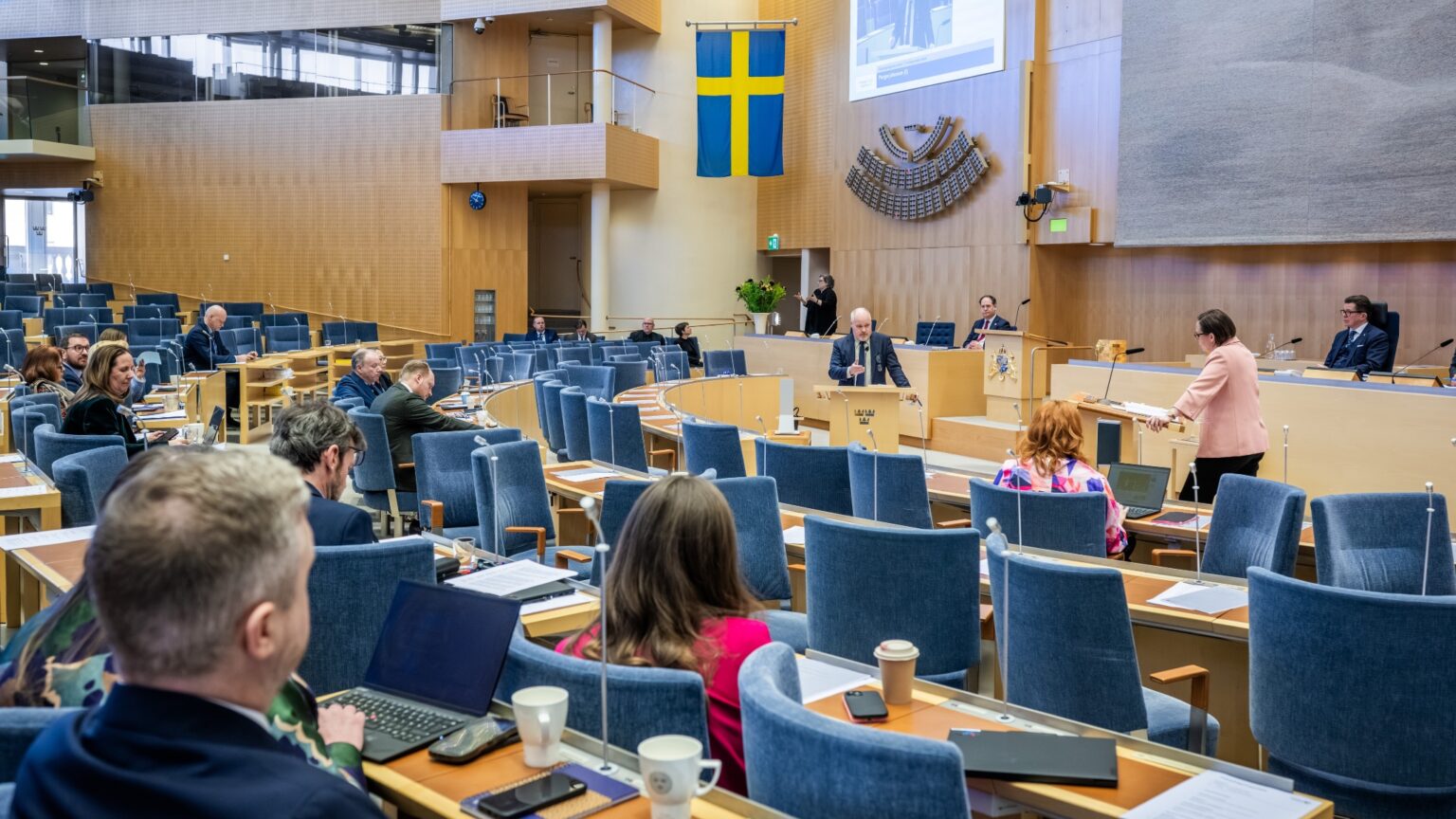
The most obvious difference is tone. Swedish parliamentary debate is calm, structured, and formal. Members of the Riksdag address the Speaker rather than each other, and raising your voice or interrupting is genuinely unusual. When a Swedish politician says “we see this somewhat differently,” it often signals a deep ideological disagreement expressed in the mildest possible language.
The deeper difference is the consensus culture — a tradition of seeking agreement through commissions, expert consultation, and negotiation before major decisions are taken. Large reforms in Sweden are typically preceded by years of SOU (Statens offentliga utredningar) — government inquiry reports compiled by multi-party and expert commissions — before anything reaches the Riksdag.
Central to this culture is the relationship between the Social Democrats and LO, the Swedish Trade Union Confederation. LO organizes a large portion of Sweden’s blue-collar workforce and has historically been the organizational and financial backbone of the Social Democratic party. Swedish labor market rules are largely determined not by legislation but by collective agreements between unions and employer associations — a system known as the Swedish Model.
One thing has genuinely changed: Sweden’s political tone has hardened significantly since 2015. The consensus that existed across most parties on immigration policy broke apart under the pressure of the 2015 refugee crisis. Almost every party, with the exception of the Greens and the Left, shifted toward more restrictive positions. The current government’s migration policy is the most restrictive in Swedish post-war history.
How to follow Swedish politics as a foreigner
You do not need to be fluent in Swedish to start following Swedish politics. A few resources make it accessible regardless of where you are in your language learning.
SVT Nyheter på lätt svenska broadcasts daily television news in simplified Swedish with slower pacing and straightforward vocabulary — excellent for both language practice and political understanding. Radio Sweden på lätt svenska from Sveriges Radio provides daily podcast summaries in accessible Swedish. 8 Sidor writes all news in easy-to-read Swedish, specifically aimed at people learning the language.
For watching politics in action, the Riksdag’s webb-TV service (riksdagen.se) streams all parliamentary debates live and archives every session freely. The most engaging viewing for understanding how parties actually differ is the Partiledardebatten — the party leaders’ debate — which takes place several times each year.
Swedish politics rewards patience and observation. The system is deliberately designed to be transparent — all official documents are public, all parliamentary debates are recorded, and the voter matching tools are built by people who genuinely want citizens to make informed choices.
If you found this guide useful and want to share which party matched your views in the SVT Valkompass — or if you have questions about any of the parties — leave a comment below. We read every one. And if this kind of deep-dive into Swedish society is the sort of content you want more of, subscribing to the LikeSweden newsletter is the best way to get it directly to your inbox.